
You already have Power BI. Do you need Willow?
This is one of the most common questions we hear from multi-site aged care providers, and it deserves a straight answer.
If your organisation has invested in Power BI, a data lake, and executive dashboards, you have done something most of the sector has not. Your quality indicators, incidents, workforce and risk data are visible in one place. That investment matters, and Willow builds on it rather than replacing it.
The distinction comes down to one sentence.
Power BI displays your data. Willow interprets it.


What Power BI does brilliantly
Power BI is one of the best business intelligence tools ever made. In an aged care context it gives you consolidated reporting across sites and systems, executive dashboards on the metrics you choose, trend analysis, and self-serve exploration for teams with the skills to use it.
If a number exists in your data lake, Power BI can chart it. Nothing on this page argues otherwise.
What it cannot do is look at the chart and tell you what it means. And it certainly cannot fill in the Commission's paperwork, run a deadline clock, or chase a gap through to closure.
What interpretation looks like in practice
Open Willow's compliance insights and you are not looking at a chart waiting to be understood. You are looking at an executive summary the platform wrote from your live data: how your compliance position has moved, where it is predicted to be in three months, and the three to five areas that most deserve attention now, with the underlying data one click away.
Beneath that sits the compliance heatmap: every site in your organisation against every Standard, colour-coded, with drill-down from organisation to site to ward. Your quality indicators are benchmarked against the national data published by the AIHW, so you see not just your falls rate but which percentile of the sector it puts you in. And Willow's Star Rating engine estimates each home's rating before submission, runs what-if scenarios — what happens to Quality Measures stars if falls stay at this rate for another quarter — and alerts you when a sub-category starts to slide. A predicted drop in a public Star Rating is a commercial event, and Willow is built to see it coming.
When Willow detects a compliance gap, it does not stop at showing it to you. It opens a remediation action, assigns it an owner, and tracks it to closure.
A Power BI dashboard answers the question you thought to build a report for. Willow tells you which questions you should be asking this week.

Six things a BI tool cannot do, no matter how well it is built

Analyse, predict and prioritise on its own
Power BI shows a falls rate rising at one site. Someone senior still has to notice it, compare it across facilities, and decide it matters. Willow performs that synthesis continuously: AI-written trend summaries, a three-month compliance score prediction, Star Rating forecasting with decline alerts, and a suggested focus list — with the reasoning and the underlying data one click away.


Maintain the regulatory logic
Every compliance report in your Power BI estate encodes rules a person built by hand: which measures map to which of the 33 outcomes under the strengthened Quality Standards, what counts toward care minutes targets, which incident types carry SIRS obligations. When guidance changes, someone rebuilds the reports. When that analyst leaves, the logic leaves with them.
Willow maintains the regulatory framework as a product: all 7 Standards and 33 outcomes of the strengthened Quality Standards, modelled down to the level of the 154 individual actions, kept current centrally. Indicator definitions are versioned, so a historical quarter always recalculates exactly as it was calculated at the time. And when the rules change, Willow's regulatory change radar does not just tell you something changed — it tells you which of your policies, evidence and processes the change touches.


Produce evidence, not metrics
A Commission assessor does not accept a dashboard. They want evidence mapped to specific outcomes with version history: the policy, the training record, the audit result, the meeting minute. Willow assembles audit-ready evidence packs per site — including short-notice readiness packs built for a 24-hour assessment window — and even generates evidence automatically from your operational data, so preparation becomes a review rather than a scramble.
Willow's mock-audit mode goes further, working your team through the questions assessors actually ask and converting every question you cannot yet answer into a tracked gap.


Read your documents
BI tools run on structured data. A large share of what proves compliance is unstructured: policies, procedures, clinical documentation, meeting minutes, complaint correspondence.
Willow's AI reads those documents — including scanned ones — maps them to the specific requirements they evidence, routes low-confidence matches to a human for review, and surfaces what your document set fails to cover. It also learns your organisation: suggestions your team rejects stop being made.


Carry a gap through to closure
Reporting ends at visibility. Compliance ends at closure. Willow runs continuous monitors over your live data — threshold rules that automatically open a remediation action when they fail, assign it to the right owner, and notify them.
Complaints carry enforced SLA timers. SIRS and NDIS notifications carry live deadline clocks. Every identified gap moves through a workflow with ownership, status, and evidence of resolution, so board reporting shows what is being fixed alongside what is going wrong.


Fill in the regulator's actual paperwork
This is the point where the comparison stops being close. When your registration renewal comes around, the Commission hands you its Audit Evidence Collection Tool and Care Delivery Evidence Collection documents — up to 144 narrative answers across every outcome, each of which must be backed by evidence.
Willow completes them. It drafts each answer from the evidence actually linked to that outcome, with citations, for your team to review and approve. It tracks ownership and freshness of every answer between renewal cycles, so the work never goes stale. And it compiles the approved answers and the cited evidence files into a submission-ready pack, in the Commission's own templates.
Power BI can chart your falls rate. It cannot write outcome 5.4's evidence narrative into the Commission's workbook. No dashboard can.


AI you can defend to an assessor
Plenty of software now claims AI. What matters in a regulated environment is AI you can stand behind when an assessor asks how a conclusion was reached.
Willow's AI never marks a requirement compliant — a compliance judgement is always made by a person, and the platform enforces that architecturally. AI-drafted answers carry citations to the underlying evidence, and when the evidence is not there, Willow says so rather than inventing something. Every AI-suggested link records the model and prompt version that produced it and can be reversed with one click. And Willow operates its AI under a management system aligned to ISO/IEC 42001, the international standard for responsible AI — with certification underway.
That is the difference between AI as a feature and AI as something your governance committee can approve.
Loading....
Your systems stay the source of truth
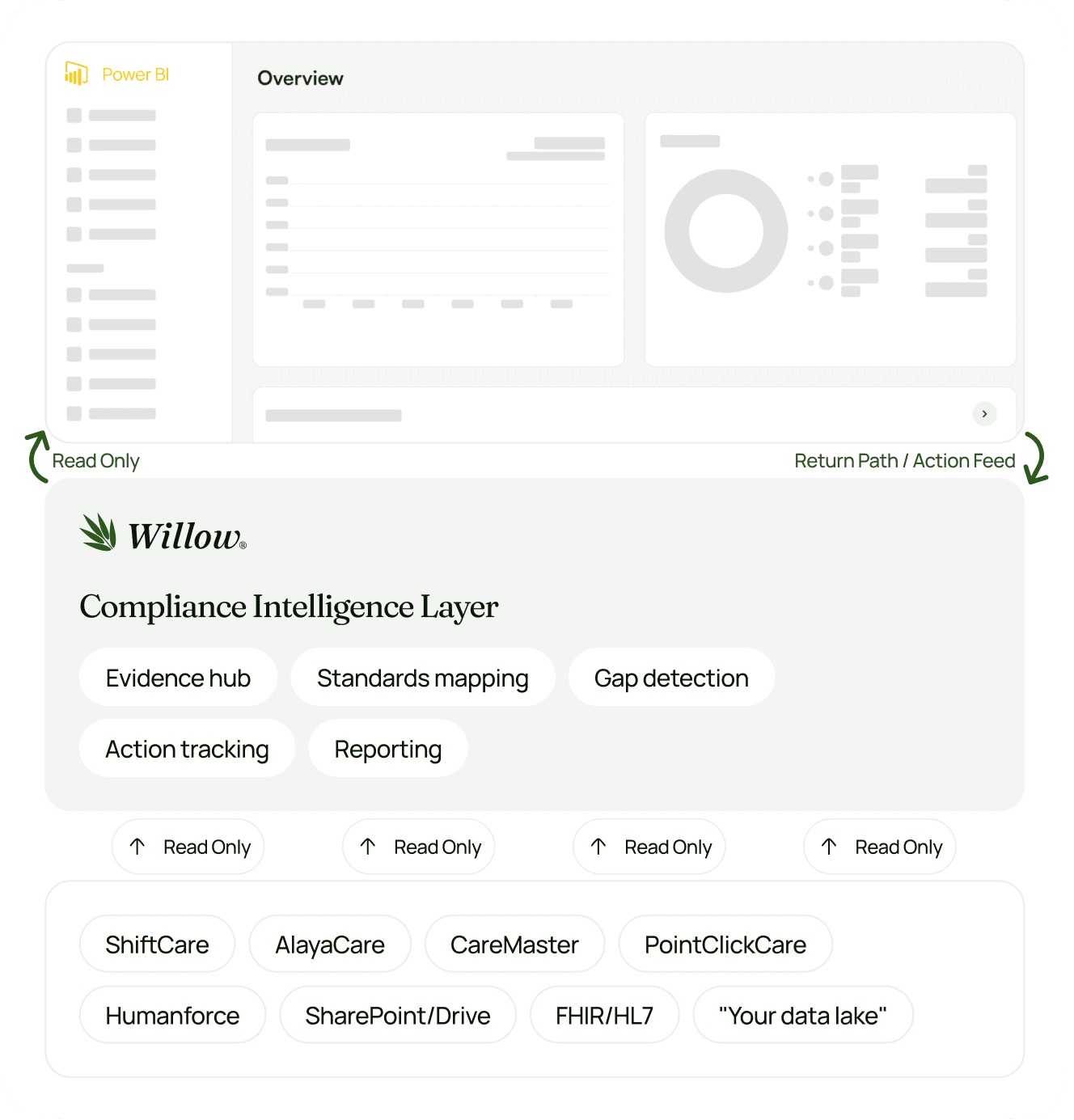
Willow is an orchestration layer, and this is where your existing data investment becomes an advantage rather than a hurdle.
Willow syncs from the systems you already run — care management platforms like ShiftCare, AlayaCare, CareMaster and PointClickCare, workforce tools like Humanforce, document stores like SharePoint, OneDrive and Google Drive, and clinical systems via FHIR and HL7 — or from a centralised data lake if you have one. The sync is read-only by design: Willow never writes to your clinical or operational systems. There is no duplicate entry and no migration, and your operational systems remain the source of truth for their own records. For providers whose data is already centralised, implementation is faster, because the integration groundwork is already done.
And the flow runs both ways for reporting: Willow's REST API, webhooks and exports mean the compliance intelligence Willow produces can feed straight back into your Power BI estate, so board packs stay in the tools your executives use today.
Three questions worth asking internally
If those answers are quick and confident, your compliance operation is in rare shape. If any of them gave you pause, that pause is the gap Willow closes.
See it against your own data environment
Willow supports your governance and compliance decision-making. It does not replace your obligations under the regulatory framework, and no platform can guarantee a compliance outcome. What it can do is give your leadership continuous, interpreted, evidenced visibility of where you stand — and a closed loop from every gap to its resolution.
If your organisation runs Power BI today, a 30-minute conversation will show you exactly how the two fit together.