
The Complete NDIS Audit Guide 2026: Practice Standards, New Requirements & Commission Preparation
Compliance
May 18, 2026
Why regulated care providers must move beyond audit cycles and build real-time compliance systems.
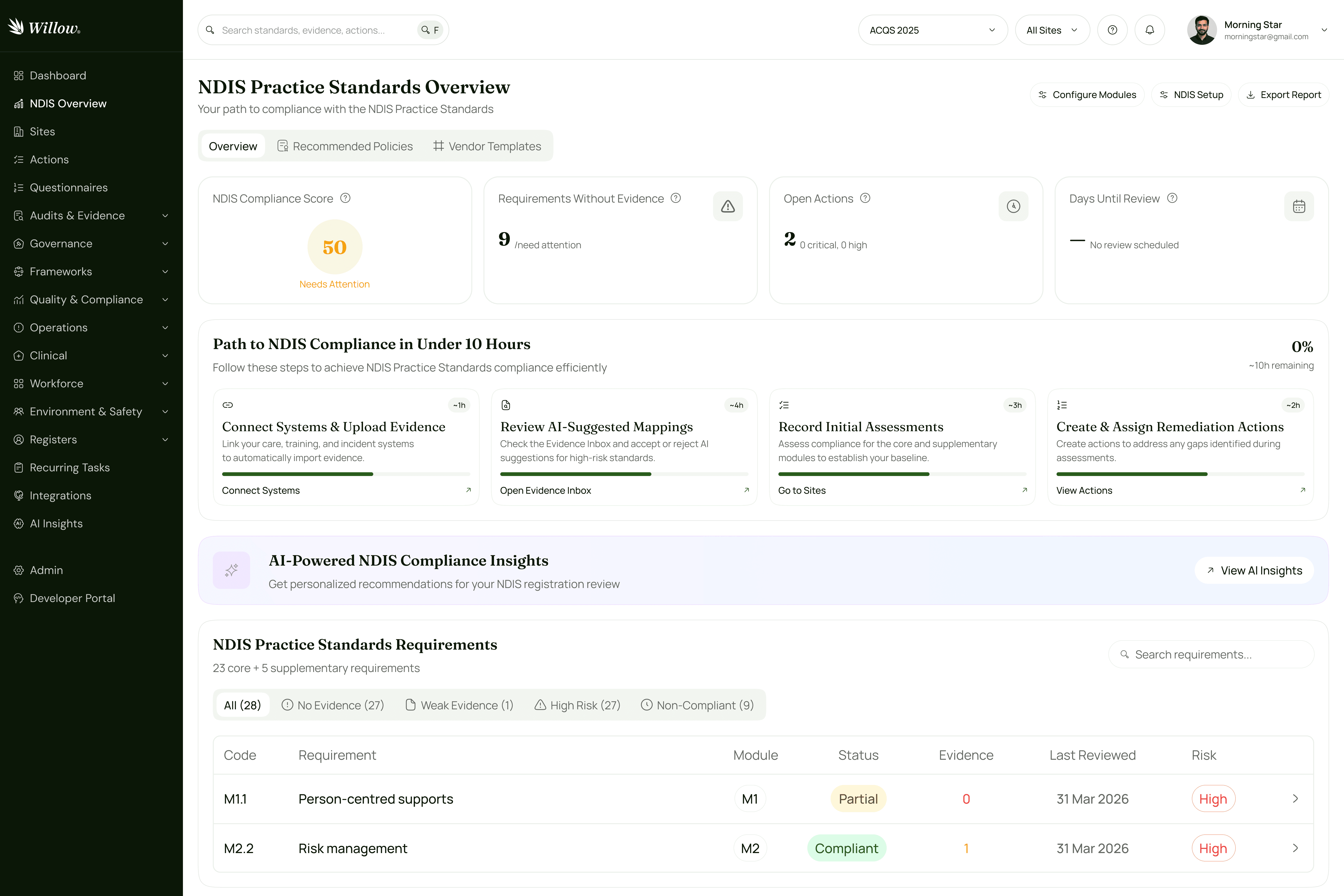
The compliance landscape for NDIS providers has shifted dramatically. With the NDIS Amendment (Integrity and Safeguarding) Act 2026 now law, the July 1 deadline for mandatory SIL provider registration approaching, and the NDIS Quality and Safeguards Commission conducting increasingly rigorous audits, providers face one of the most demanding regulatory environments in the scheme's history.
For compliance and quality leaders, the message is clear: audit readiness can no longer be an annual scramble. It must be built into daily operations, supported by systems that continuously demonstrate compliance rather than reconstruct it when the auditor arrives.
🛠️ Free Tool: NDIS Practice Standards Self-Assessment
Run a quick self-assessment against the NDIS Practice Standards to identify your biggest compliance gaps before your audit.
Part 1: Understanding the NDIS Practice Standards Framework
The NDIS Practice Standards establish the benchmarks for quality and safety in NDIS service delivery. They work alongside the NDIS Code of Conduct to ensure participants receive supports that respect their rights, promote their wellbeing, and deliver genuine outcomes.
The Four Core Modules
The NDIS practice standards are organised into four modules:
Module 1: Rights and Responsibilities — All providers. Focus on participant rights, dignity, choice and control.
Module 2: Governance and Operational Management — All providers. Leadership, governance, risk management, continuous improvement.
Module 3: Provision of Supports — All providers delivering supports. Safe, effective support delivery, workforce competence.
Module 4: Provision of Specialist Behavioural Supports — Behaviour support providers only. Restrictive practices, behaviour support plans.
Each module contains specific outcomes that auditors assess against. Understanding which modules apply to your registration groups is essential for targeted preparation.
Part 2: The NDIS Audit Process — What Actually Happens
Understanding the audit process helps you prepare effectively and reduce anxiety for your team.
Types of Audits
Initial Audit: Before first registration or adding new registration groups. Comprehensive assessment of all applicable modules. 1-3 days depending on size.
Mid-Term Review: Approximately 18 months into 3-year registration. Focused on high-risk areas and previous non-conformities. 1-2 days.
Renewal Audit: Before registration expiry. Similar scope to initial audit with focus on continuous improvement and incident trends.
Targeted Audit: Triggered by complaints, incidents, or regulatory concerns. Focused on specific areas. Can be announced or unannounced.
Audit Timeline
4-6 weeks before: Notification and scope confirmation, self-assessment review, evidence preparation. During: Opening meeting, document review, staff interviews, participant interviews (consented), site observations, closing meeting. After: Draft report within 10 days, provider response, corrective action plan, Commission decision.
Part 3: What Auditors Actually Look For
Auditors assess against the NDIS practice standards using four evidence categories:
1. Documented Information
Policies and procedures (current, approved, accessible), forms and templates (guiding good practice), records and documentation (service delivery evidence). Auditors want documents that are actually used, not just stored.
2. Implementation Evidence
Participant files showing current support plans and review evidence, staff records with verified qualifications and training, operational records including rosters and incident registers. Auditors look for consistent application across the organisation.
3. Participant and Stakeholder Input
Participant interviews (with consent) focusing on experience not just documentation, family/representative input where appropriate, staff interviews at all levels. This is often where cultural issues are identified.
4. Observation and Environment
Site visits assessing safety and accessibility, support delivery observation where agreed, verification of safe practices. Auditors want environments that support dignity and independence.
Part 4: Common Non-Conformities and How to Avoid Them
Based on Commission data and industry experience, these are the most common areas where providers fall short.
High-Risk Non-Conformities
Restrictive Practice Breaches: Using practices without authorisation, expired authorisations, exceeding authorised scope. Prevention: Robust monitoring system, regular review, clear escalation pathways.
Worker Screening Failures: Staff working before clearance received, failure to verify qualifications. Prevention: No-start policy without clearance, centralised tracking, regular file audits.
Incident Management Gaps: Incidents not reported to Commission when required, inadequate investigation, no root cause analysis. Prevention: Clear classification guidelines, investigation training, tracking system for corrective actions.
Medium-Risk Non-Conformities
Support Planning Deficiencies: Plans not developed with participants, goals not measurable. Prevention: Participant involvement, regular review schedules.
Supervision and Training Shortfalls: Staff without current mandatory training. Prevention: Training matrix with expiry tracking, scheduled supervision.
Part 5: The 2026 Changes — What's New
The NDIS Amendment (Integrity and Safeguarding) Act 2026 represents the most significant regulatory overhaul since the scheme's inception.
Key Legislative Changes
1. Mandatory SIL Provider Registration (July 1, 2026): All SIL providers must be registered by July 1, 2026. Unregistered providers face penalties and exclusion. Registration requires compliance with full Practice Standards.
2. Strengthened Worker Screening: Enhanced NDIS Worker Screening Check requirements, broader categories requiring screening, stricter exclusion periods, real-time monitoring of worker status.
3. New Reporting Obligations: Expanded mandatory incident reporting, financial sustainability reporting for larger providers, quarterly compliance attestations for high-risk categories.
4. Increased Penalties and Enforcement: Higher civil penalties, new criminal offences for serious breaches, expanded Commission powers, public naming of providers with serious failures.
What This Means for Audit Preparation
Broader scope — auditors will examine readiness for upcoming requirements. Deeper scrutiny — more rigorous assessment of governance, financial viability, and outcomes. Shorter timelines for corrective actions. Technology expectations — real-time compliance visibility, not paper records.
Part 6: Preparing for Your NDIS Audit
Effective preparation reduces stress and improves outcomes. Here's a systematic approach.
90 Days Before: Foundation Work
Review and update documentation to reflect current practice AND upcoming 2026 requirements. Conduct internal audit including 2026 readiness assessment. Engage your team — brief all staff, clarify roles, address anxiety, ensure 2026 changes are understood.
30 Days Before: Evidence Compilation
Create evidence packs organised by module and outcome. Document 2026 transition activities. Verify participant consent for interviews. Finalise logistics — confirm venue, schedule key staff, prepare technology access.
7 Days Before: Final Preparation
Staff briefing reinforcing key messages, practice interview questions, review 2026 changes. Final review of critical documents. Confirm 2026 transition evidence is ready.
Technology's Role
Modern compliance management systems significantly improve audit preparation. Essential capabilities include document management with version control, incident and complaint management, workforce management with training tracking, and secure participant records.
🛠️ Try our free NDIS Practice Standards Self-Assessment — Identify your biggest compliance gaps before your audit.
Part 7: Post-Audit — Responding to Non-Conformities
Even well-prepared providers may receive non-conformities. How you respond matters.
Understanding Non-Conformity Levels
Critical: Immediate risk to participant safety, serious breach of NDIS Act, requires immediate action, may affect registration.
Major: Significant failure to meet standards, systemic issues, requires comprehensive corrective action, typically 3 months.
Minor: Isolated failure, low risk, targeted corrective action, typically 1-3 months.
Developing Corrective Action Plans
Root cause analysis — why did this happen, what systems failed. Corrective actions — immediate risk address, system changes to prevent recurrence. Timeframes — realistic but prompt, prioritise by risk.
Verification and Evidence
Auditors want evidence that corrective actions are effective: updated policies, training records, changed documentation, staff and participant feedback.
Part 8: Willow for NDIS Compliance
Willow provides an AI-powered compliance workspace designed specifically for NDIS providers navigating the NDIS practice standards and preparing for 2026 changes.
Key Features
Evidence mapping to all practice standards outcomes. Real-time compliance dashboards. Automated incident classification and reporting. AI-powered gap detection and policy drafting. Board-ready governance reporting. Integration with existing participant management systems. 2026 transition planning tools.
Conclusion: Building Audit-Ready Organisations
The NDIS Practice Standards audit isn't just a compliance hurdle — it's an opportunity to validate that your organisation genuinely delivers quality supports that improve participants' lives.
With the 2026 changes bringing stricter requirements, mandatory SIL registration, and enhanced enforcement, the providers who thrive will be those who view compliance as continuous improvement rather than an annual inspection to survive.
The investment in robust systems, competent staff, and participant-centred practice pays dividends not just in audit outcomes, but in reputation, staff satisfaction, and participant outcomes.
The question isn't whether you can pass an audit — it's whether you've built an organisation that delivers quality supports every day. The audit simply verifies what you already know about your organisation's commitment to excellence.
Related Articles:
The Complete Guide to Strengthened Aged Care Quality Standards 2025
ACQS 2025: The Complete Guide to New Aged Care Quality Standards
SIRS Reporting in Aged Care: A Complete Guide
NDIS SIL Provider Registration: The July 2026 Deadline
Written by

James Driscoll
Writer
Latest Articles & Guides
Stay informed with the latest guides and news.



Ready to Move From Reactive to Continuous Compliance?
See how Willow supports structured governance, real-time monitoring, and audit-ready operations.