
Aged Care Compliance Checklist 2026: ACQS Strengthened Standards
Compliance
May 28, 2026
Why regulated care providers must move beyond audit cycles and build real-time compliance systems.

Compliance under the Strengthened Aged Care Quality Standards (ACQS 2025) requires a structured approach. This checklist gives you a practical, requirement-by-requirement framework to assess your readiness across all 7 standards.
An aged care compliance checklist is a structured tool that helps Australian providers self-assess their performance against the Strengthened Aged Care Quality Standards (ACQS 2025) before a Commission audit.
Use this as a living document. Rate each item as Met, Partially Met, or Not Met. Where gaps exist, assign an owner, set a deadline, and track progress. The goal is not perfection on day one — it is a clear picture of where you stand and a plan to close the gaps.
🛠️ Try our free ACQS 2025 Self-Assessment
Run a quick self-assessment against all 7 Strengthened Aged Care Quality Standards to identify your biggest compliance gaps.
Standard 1: The Person
Rights, dignity, and individual identity
☐ Each person has a current, individualised care plan that reflects their preferences, goals, and life history
☐ Informed consent processes are documented and consistently applied
☐ Supported decision-making frameworks are in place for people with cognitive impairment
☐ Privacy and confidentiality practices are documented and staff can articulate them
☐ Processes exist to identify and respond to abuse and neglect, with evidence of staff training
☐ People receiving care can describe how their preferences are respected (consumer feedback)
☐ Cultural, spiritual, and personal identity needs are assessed and documented in care plans
☐ Evidence exists of regular care plan reviews with consumer and family involvement
Standard 2: The Organisation
Governance, leadership, culture, and workforce
☐ Board/executive governance structure is documented with clear accountability for care quality
☐ Regular clinical governance reporting to the board occurs (at least quarterly)
☐ Named clinical governance lead with defined responsibilities
☐ Risk management framework is current, with a risk register that is actively reviewed
☐ Organisational culture assessment has been conducted (staff survey, culture preparing for your ACQS 2025 audit)
☐ Workforce plan demonstrates adequate staffing levels, including RN coverage
☐ Care minutes compliance is tracked and reported (actual vs mandated)
☐ Staff competency framework exists with evidence of ongoing education and assessment
☐ Open disclosure policy is in place and staff are trained in its application
☐ Medication management governance includes regular auditing and trend analysis
☐ Restrictive practices governance includes a register, review schedule, and reduction strategy
☐ Quality improvement program is structured with measurable objectives and progress tracking
Standard 3: The Care and Services
Assessment, planning, clinical care, daily living
☐ Comprehensive assessments are conducted on entry and at regular intervals
☐ Care plans are based on assessed needs and best-practice evidence
☐ Clinical care is delivered by qualified staff within their scope of practice
☐ Medication management follows best-practice guidelines with regular auditing
☐ Pain management is assessed, documented, and regularly reviewed
☐ Wound management protocols are in place with outcome tracking
☐ Falls prevention program exists with data on falls rates and trends
☐ Continence management is individualised and documented
☐ Palliative and end-of-life care planning is documented with advance care directives
☐ Daily living support (mobility, personal care, social engagement) is documented and person-centred
☐ Care transitions (hospital transfers, service changes) follow documented protocols
☐ Infection prevention and control program is current with staff training records
Standard 4: The Environment
Safety, comfort, accessibility
☐ Physical environment meets safety standards with regular hazard assessments
☐ Equipment is maintained, serviced, and fit for purpose
☐ Living spaces are comfortable, homely, and accessible
☐ Outdoor spaces are accessible and safe
☐ Emergency and evacuation plans are current and regularly practiced
☐ Infection control measures are embedded in the physical environment
☐ Environment supports orientation and wayfinding for people with cognitive impairment
☐ Maintenance requests are tracked with response time data
Standard 5: Feedback and Complaints
Accessible, responsive, transparent processes
☐ Complaints policy is accessible and available in multiple formats and languages
☐ People receiving care know how to make a complaint (consumer awareness)
☐ Complaints are logged, investigated, and resolved within defined timeframes
☐ Complainants receive feedback on the outcome of their complaint
☐ Complaint trends are analysed and reported to leadership
☐ Evidence exists of service improvements driven by complaints and feedback
☐ Regular consumer satisfaction surveys or feedback mechanisms are in place
☐ Staff are trained in receiving and escalating complaints without defensiveness
Standard 6: Diversity
Culturally safe, inclusive care
☐ Cultural assessment is part of the intake and care planning process
☐ Staff cultural competency training is documented and current
☐ Interpreter and translation services are available and utilised
☐ Care practices are adapted for Aboriginal and Torres Strait Islander peoples
☐ LGBTQI+ inclusive practices are documented and staff are trained
☐ Services are accessible for people with disability, sensory impairment, or cognitive decline
☐ Community consultation or partnership evidence exists for relevant cultural groups
☐ Information is available in languages relevant to your consumer population
Standard 7: Food and Nutrition
Quality, choice, nutritional adequacy
☐ Menu is reviewed by a qualified dietitian or nutritionist
☐ Meals meet nutritional guidelines for older Australians
☐ Individual dietary needs, preferences, and cultural requirements are documented and met
☐ Texture-modified and therapeutic diets are available
☐ Resident satisfaction with food is regularly assessed
☐ Mealtime experience supports dignity and social connection
☐ Weight monitoring is conducted with referral protocols for unplanned weight loss
☐ Hydration monitoring and management processes are in place
☐ Food safety and hygiene practices are documented and audited
How to Use This Checklist
This checklist is most effective when used as a team exercise, not a solo preparing for your ACQS 2025 audit.
Recommended approach:
Assign each standard to the most relevant leader (e.g., Standard 3 to the Director of Nursing, Standard 2 to the CEO)
Each leader rates their standard items as Met, Partially Met, or Not Met
Convene a leadership meeting to review the consolidated results
For each Not Met or Partially Met item, assign an owner, deadline, and specific actions
Review progress monthly — this becomes your continuous improvement evidence
The act of doing this assessment and tracking your progress against it is itself evidence of quality governance. Assessors specifically look for evidence that organisations self-assess, identify gaps, and take structured action to address them.
From Checklist to Continuous Compliance
A checklist is a starting point, not the destination. True ACQS 2025 compliance requires continuous monitoring, evidence collection, and improvement — not a point-in-time check.
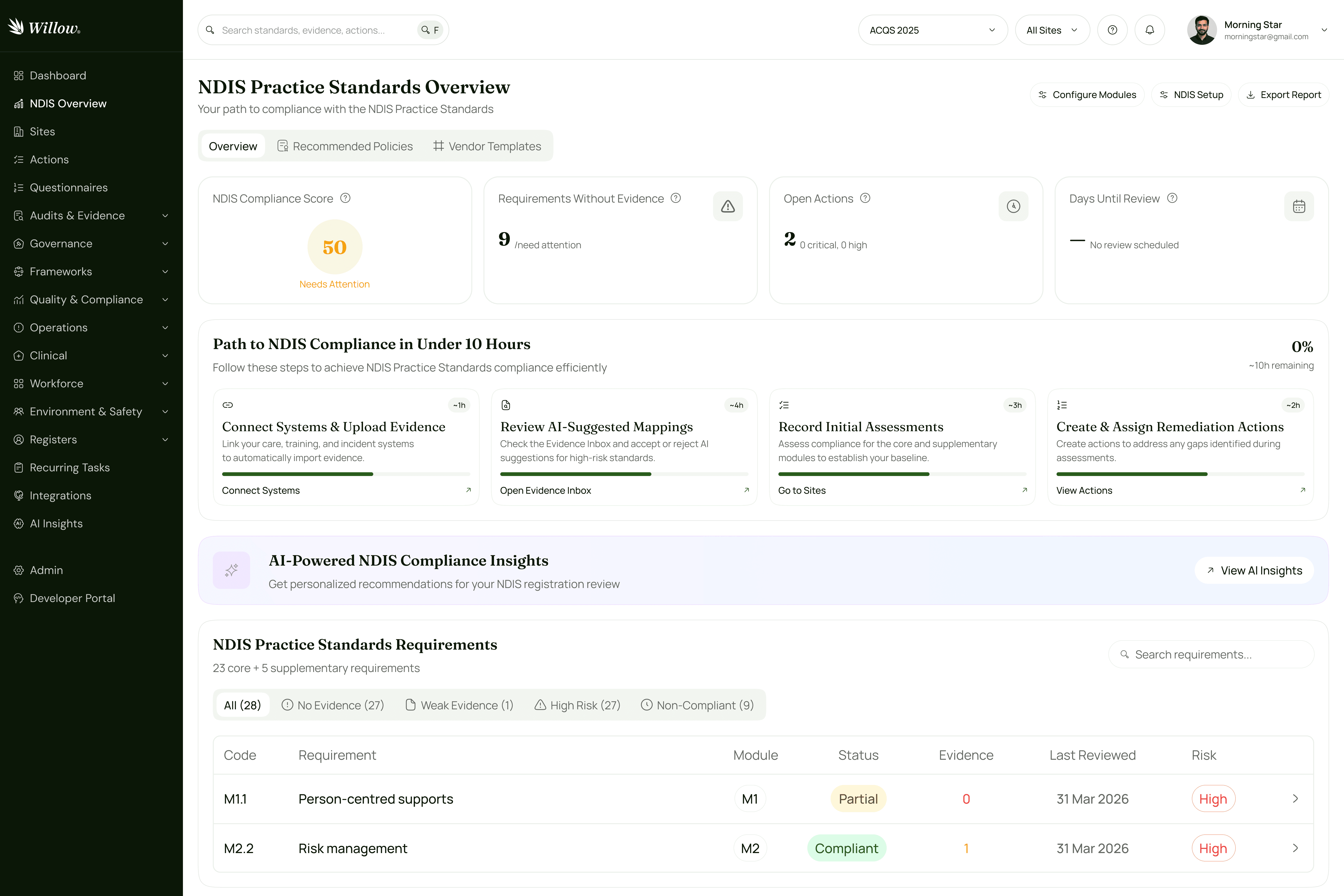
This is where compliance technology makes the difference. Platforms like Willow take the checklist approach and automate it — mapping your evidence across all 7 standards in real time, flagging gaps as they emerge, and keeping you preparing for your ACQS 2025 audit-ready every day rather than just on checklist day.
Want to move from periodic checklists to continuous compliance? Book a demo of Willow to see how it works.
🛠️ Try our free ACQS 2025 Self-Assessment
Run a quick self-assessment against all 7 Strengthened Aged Care Quality Standards to identify your biggest compliance gaps.
Written by

James Driscoll
Writer
Latest Articles & Guides
Stay informed with the latest guides and news.


Ready to Move From Reactive to Continuous Compliance?
See how Willow supports structured governance, real-time monitoring, and audit-ready operations.