
Aged Care Quality Management System (QMS): The Complete 2026 Guide
Compliance
28 July 2026
What an aged care quality management system (QMS) actually is, what it must contain under the strengthened Aged Care Quality Standards, how to build or choose one, and the mistakes that put providers at risk. A practical guide for Australian aged care providers.

An aged care quality management system (QMS) is the framework a provider uses to plan, deliver, monitor and continuously improve the quality and safety of care. Under the strengthened Aged Care Quality Standards, which took effect on 1 November 2025, a well-run QMS has shifted from a nice-to-have into the operational backbone of every compliant provider in Australia.
This guide explains, in plain language, what an aged care quality management system is, what it must contain, how the strengthened standards raise the bar, and how to build or choose a QMS that keeps your organisation genuinely audit-ready rather than scrambling before every assessment.
Whether you run a single residential facility, a national multi-site group, or home care and Support at Home services, the principles here apply — the difference is scale and the tooling you use to manage it.
What Is an Aged Care Quality Management System?
A quality management system (QMS) is the structured set of policies, processes, records, roles and continuous-improvement activities an organisation uses to consistently deliver quality outcomes and meet its regulatory obligations. In aged care, a QMS is what connects the promise of safe, dignified, person-centred care to the day-to-day evidence that it is actually happening.
In an Australian aged care context, the purpose of a QMS is to help providers:
Meet the strengthened Aged Care Quality Standards and the Aged Care Act 2024
Embed best-practice processes that staff can follow consistently
Capture and organise the evidence needed to demonstrate compliance
Identify risks and gaps early, then track them to resolution
Prepare for accreditation and Quality and Safety Commission assessments without a last-minute scramble
It is worth being clear about what a QMS is not. A QMS is not a clinical system, an electronic health record, or a rostering platform. Those systems run your operations. A quality management system sits above them — it is the governance and evidence layer that turns operational activity into a defensible, continuously improving compliance position.
Why a QMS Matters More Than Ever in 2026
The regulatory environment for aged care in Australia has changed profoundly. The Royal Commission into Aged Care Quality and Safety exposed systemic failures, and the government's response has reshaped how quality is defined, assessed and enforced.
Three developments make a robust quality management system essential:
The strengthened Aged Care Quality Standards took effect on 1 November 2025, moving from eight standards to seven, with a far stronger emphasis on outcomes, clinical care, food and nutrition, dignity and governance.
The Aged Care Act 2024 introduced a new regulatory model with tighter provider obligations and stronger powers for the Aged Care Quality and Safety Commission (ACQSC).
Star Ratings and public reporting mean quality performance is now visible to older people and their families, directly influencing consumer choice and reputation.
Crucially, the strengthened standards are outcomes-based. It is no longer enough to show a policy exists — providers must demonstrate that it is working in practice, backed by current evidence. That is precisely what a well-designed quality management system is built to do. You can read our complete guide to the strengthened Aged Care Quality Standards for a deeper breakdown of the framework.
The 7 Standards Your QMS Must Cover
The strengthened Aged Care Quality Standards published by the Aged Care Quality and Safety Commission are the backbone your QMS must map to. Standards 1 to 6 apply to residential and home care (including Support at Home); Standard 7 applies specifically to residential care.
Standard 1 — The Individual: dignity, respect, choice, identity and culturally safe care
Standard 2 — The Organisation: governance, leadership, accountability and workforce culture
Standard 3 — The Care and Services: assessment, planning and coordinated delivery of care
Standard 4 — The Environment: a safe, comfortable and enabling physical environment
Standard 5 — Clinical Care: clinical governance, medication management, infection control and deterioration response
Standard 6 — Food and Nutrition: quality, choice and nutritional adequacy of meals
Standard 7 — The Residential Community: community life, social connection and quality of life in residential settings
A capable quality management system lets you self-assess against each standard, attach the evidence that supports each requirement, and see at a glance where you are strong and where you have gaps — by standard, by requirement, and across every site.
The Core Components of an Effective Aged Care QMS
Whatever tools you use, a genuinely effective aged care quality management system contains the same essential building blocks. If any of these is missing or lives in a silo, your compliance position is weaker than it looks.
Policies and procedures — current, framework-aligned documents that guide staff, with version control and staff attestation
Evidence management — a central repository so proof of compliance is not scattered across drives, inboxes and spreadsheets
Incident and SIRS management — capture, investigation, root-cause analysis and timely reporting under the Serious Incident Response Scheme
Complaints and feedback — accessible channels, tracked responses and evidence of learning from feedback
Internal audit — scheduled audits, assigned actions and recorded evidence against each standard
Risk management — a live register to identify, assess, treat and monitor risks
Quality indicators and care minutes — accurate reporting to the National Quality Indicator Program and against care-minute targets
Workforce and training — tracking of qualifications, mandatory training and competency
Continuous improvement — a Plan-Do-Check-Act loop that turns findings into tracked, closed-out actions
The strength of a QMS comes not from having these components, but from connecting them — so a single incident, complaint or audit finding flows automatically into risk, actions and your evidence for the relevant standard.
Manual QMS vs Modern QMS Software
Many providers still run their quality management system on spreadsheets, shared drives, email threads and periodic consultant support. Under the old standards this could just about work. Under the strengthened, outcomes-based framework, it creates real and growing risk.
The limits of a manual QMS become obvious under pressure:
Evidence is fragmented across systems, so audit preparation becomes a stressful, weeks-long project every time
There is no real-time view of readiness, gaps or overdue actions across standards or sites
Mandatory reports (SIRS, quality indicators, care minutes) are assembled by hand from disconnected data
Multi-site operators cannot see risk consistently across facilities
Modern aged care QMS software addresses this by centralising evidence, mapping it to each requirement of the strengthened standards, surfacing gaps early, and generating audit-ready documentation on demand. Instead of point-in-time compliance, providers move to continuous compliance — always ready, not just ready for the next audit. For a fuller comparison, see our overview of aged care compliance software.
How to Choose an Aged Care QMS
If you are evaluating quality management systems or QMS software for aged care, use this checklist to separate genuine capability from a glossy feature list:
Maps directly to the strengthened Aged Care Quality Standards (ACQS 2025), by standard and requirement
Centralises evidence with clear links between evidence, requirements and actions
Handles SIRS, complaints, risk and continuous improvement in one connected workflow
Gives multi-site visibility — a heatmap of readiness by site and standard
Supports quality indicators and care-minute reporting without double entry
Integrates with the operational systems you already use, rather than forcing re-keying of data
Generates audit preparation packs on demand
Stores data securely and, ideally, hosts it in Australia
The single most important question to ask any vendor: "When the Commission contacts us, how quickly can this system produce the evidence for every requirement across every site?" If the honest answer is still "we export and assemble it manually," the system is a document store, not a quality management system.
Common Aged Care QMS Mistakes to Avoid
Even well-resourced providers fall into predictable traps with their quality management system. The most common — and most costly — are:
Documentation over outcomes — maintaining beautiful policies with no evidence they change practice. The strengthened standards specifically test whether requirements are understood, applied, monitored and improved.
The audit-season scramble — treating compliance as a periodic event rather than a continuous discipline, then panicking before each assessment.
Fragmented evidence — proof of compliance spread across drives, inboxes and spreadsheets, impossible to retrieve quickly under scrutiny.
No multi-site view — assuming that because one facility is strong, the whole organisation is, when risk varies significantly site to site.
Disconnected mandatory reporting — treating SIRS, quality indicators and care minutes as separate admin tasks rather than integrated signals of care quality.
Each of these is a governance failure as much as a paperwork one — and each is exactly what a well-designed QMS is meant to prevent.
How Willow Approaches Quality Management
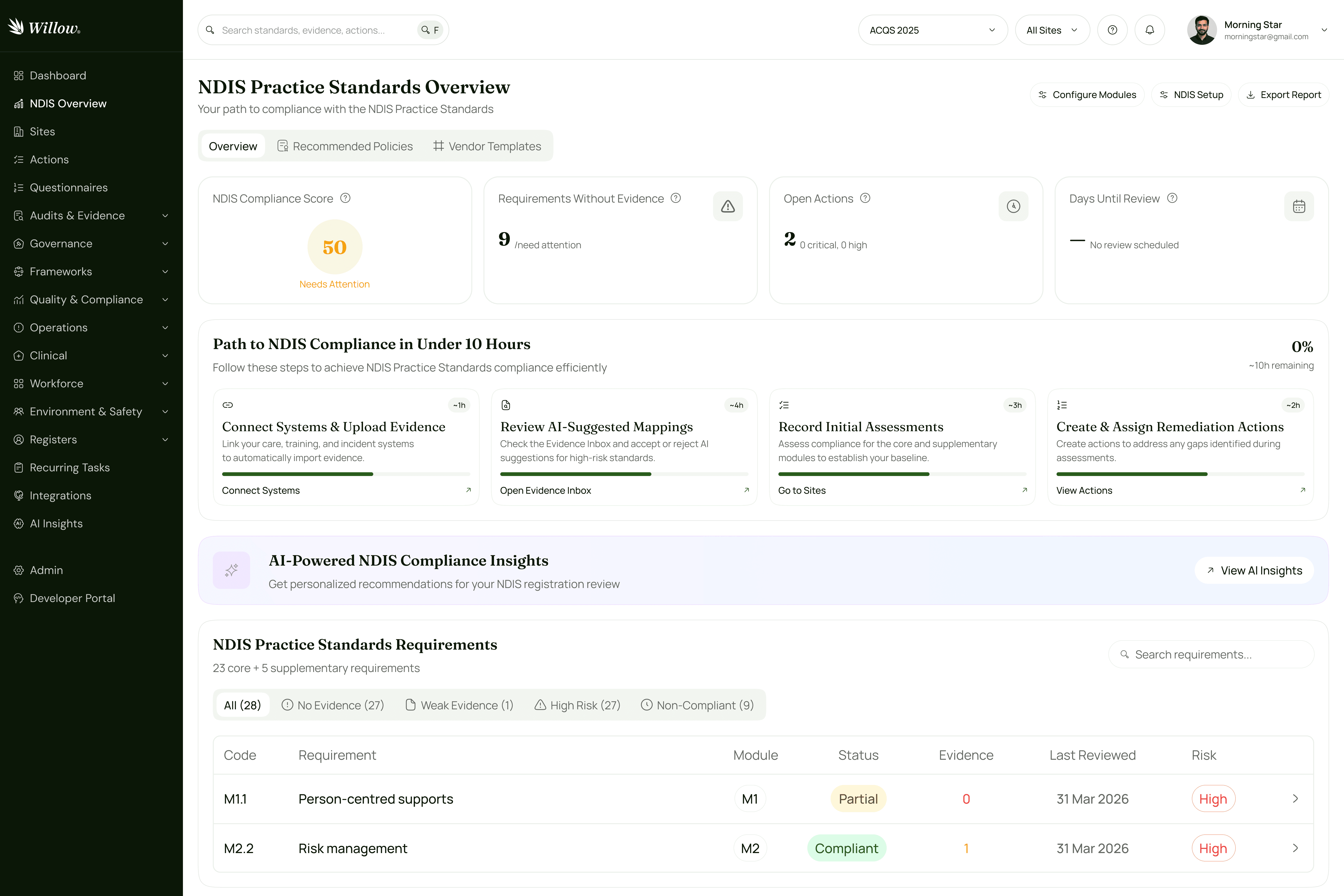
Willow is an AI-powered compliance platform built specifically for Australian aged care, home care and disability providers. Rather than replacing your clinical or operational systems, Willow acts as the intelligent quality management and governance layer that sits above them.
In practice, that means Willow helps providers:
Centralise evidence and let AI suggest how each piece maps to the strengthened Aged Care Quality Standards
Monitor readiness continuously across every standard, requirement and site
Manage SIRS, incidents, risk and continuous improvement in one connected workflow
Track quality indicators and care minutes without manual double entry
Generate audit-ready evidence packs on demand, not in a pre-audit panic
The result is a quality management system that reflects reality in real time — so leadership always knows where the organisation stands, and audit preparation becomes a routine export rather than a project. Explore our ACQS compliance software to see how it maps to the strengthened standards.
Frequently Asked Questions
Is a quality management system mandatory in aged care?
There is no single law requiring a product called a "QMS," but Australian aged care providers must demonstrate compliance with the strengthened Aged Care Quality Standards and the Aged Care Act 2024. In practice, meeting those obligations — including governance, evidence, incident reporting and continuous improvement — is impossible to do consistently without a functioning quality management system.
What is the difference between a QMS and QMS software?
A QMS is the overall system of policies, processes, records and improvement activities. QMS software is the technology that operationalises it — centralising evidence, mapping it to standards, tracking actions and producing audit-ready reports. You can run a QMS on spreadsheets, but software makes it continuous, connected and defensible.
What standards must an aged care QMS meet in 2026?
Primarily the seven strengthened Aged Care Quality Standards (effective 1 November 2025), alongside mandatory reporting obligations including the Serious Incident Response Scheme (SIRS), the National Quality Indicator Program, care minutes and restrictive practices reporting.
How does a QMS help with accreditation and audits?
A good QMS keeps evidence organised and mapped to each requirement continuously, so when the Aged Care Quality and Safety Commission conducts an assessment, you can produce current, defensible evidence across every standard and site quickly — rather than assembling it under pressure.
Want to see how a modern QMS works in practice? Book a call with Willow.
Written by

James Driscoll
Willow
Latest Articles & Guides
Stay informed with the latest guides and news.


Ready to Move From Reactive to Continuous Compliance?
See how Willow supports structured governance, real-time monitoring, and audit-ready operations.