
Audit Evidence Collection Tool (AECT): The Complete Guide for Aged Care Providers
Compliance
19 July 2026
The Audit Evidence Collection Tool (AECT) is now mandatory for aged care registration and renewal audits under the strengthened Aged Care Quality Standards. Here’s exactly what the AECT is, how it works alongside the CDECT, and how to complete it without drowning in paperwork.

If you’re preparing for an aged care registration or renewal audit, you’ve almost certainly come across the Audit Evidence Collection Tool (AECT). Since 1 November 2025, completing the AECT is a compulsory part of the audit process for providers in registration categories 4, 5 and 6 under the strengthened Aged Care Quality Standards.
For many providers, the AECT is the single most demanding document in the entire audit. It maps every Quality Standard outcome to the evidence you must produce, and the Aged Care Quality and Safety Commission (ACQSC) uses it to decide whether your registration is granted or renewed.
This guide explains what the Audit Evidence Collection Tool is, how it works for both registration and renewal, how it connects to the Care Delivery Evidence Collection Tool (CDECT), and — crucially — how aged care providers can complete it accurately without weeks of manual document-hunting.
What Is the Audit Evidence Collection Tool (AECT)?
The Audit Evidence Collection Tool (AECT) is a structured workbook issued by the Aged Care Quality and Safety Commission. It is the primary instrument the Commission uses to collect evidence about a provider’s systems and processes, and how those systems deliver safe, quality care to older people.
In simple terms: the AECT is where you demonstrate, outcome by outcome, that your organisation actually does what the strengthened Aged Care Quality Standards require — and that you can prove it with documented evidence.
The AECT is completed once per audit program and submitted, along with all supporting documents, through the ACQSC digital audit portal at the beginning of the audit. Within the tool, each Quality Standard outcome is linked to the specific supporting documents the Commission expects to see.
There are three versions of the Audit Evidence Collection Tool, depending on what you’re applying for:
AECT – Registration (for providers registering for the first time)
AECT – Renewal (for providers renewing an existing registration)
AECT – Variation (for providers varying their registration)
The AECT for Registration vs Renewal
The Audit Evidence Collection Tool applies across the provider lifecycle, but the two versions most providers deal with are registration and renewal.
AECT for Registration is used when a provider is entering the system for the first time. The focus is on demonstrating that the systems, policies and governance structures required to deliver safe, quality care are designed and in place before services begin.
AECT for Renewal is used when an existing provider’s registration comes up for renewal. Here the bar is higher: the Commission wants evidence not just that systems exist, but that they are embedded, operating in practice, and producing outcomes over time. Providers in categories 4, 5 and 6 must complete the AECT – Renewal when undergoing a renewal audit, and since 1 November 2025 this is compulsory.
For renewal audits specifically, the AECT never travels alone. It must be completed alongside the Care Delivery Evidence Collection Tool (CDECT) — which brings us to the next piece of the puzzle.
AECT and CDECT: How They Work Together
One of the most common points of confusion for providers is the relationship between the AECT and the CDECT. They are distinct tools that work together during a renewal audit.
The AECT collects evidence about your organisation-level systems and processes — how you govern, plan and manage care across the provider.
The CDECT (Care Delivery Evidence Collection Tool) collects evidence about how those systems are actually embedded and operating at the service level — in the individual home or care delivery location.
There are two versions of the CDECT depending on service type:
CDECT – Residential (Category 6) — for residential aged care homes
CDECT – Care Delivery Location (Category 4 & 5) — for care delivered in home and community settings
In practice, a multi-home operator completes one AECT for the whole organisation, plus a separate CDECT for each home (or per service region for home care). The AECT proves the system; the CDECT proves it lands on the floor.
What’s Inside the AECT: 7 Standards, 36 Outcomes
The Audit Evidence Collection Tool is structured around the strengthened Aged Care Quality Standards. That means it covers 7 Quality Standards broken into 36 outcomes, each requiring its own evidence.
For each outcome, the AECT asks providers to respond across a defined set of answer types — covering the description of your approach, the evidence that supports it, and how it is monitored and improved. This is where the tool becomes demanding: a complete AECT is not a handful of documents. It is dozens of outcomes, each cross-referenced to specific policies, records, registers and reports.
It’s also worth noting how the Standards apply by care type:
Home care providers are assessed against Standards 1–5
Standards 6 & 7 apply specifically to residential care
Because residential and home care share roughly 90–95% of their content, well-run providers prepare the shared material once and apply the care-type-specific Standards conditionally — rather than treating them as two entirely separate exercises.
Why the AECT Is So Hard to Complete Manually
On paper, the AECT looks like a workbook you fill in. In reality, most providers find it one of the most painful parts of the entire renewal process. Here’s why:
Evidence is scattered — the documents you need live across shared drives, HR systems, clinical software, email threads and filing cabinets
The same evidence supports multiple outcomes — without a mapping system, teams re-hunt and re-upload the same files repeatedly
Ownership is unclear — no single person knows the status of every outcome, so gaps surface late
Version control breaks down — when the tool is a spreadsheet passed around by email, it’s easy to submit the wrong version
There’s no live view of readiness — leadership can’t see how close the organisation actually is until the deadline is looming
The result is a familiar pattern: weeks of frantic document-gathering before an audit, duplicated effort across sites, and the constant anxiety of not knowing whether anything has been missed.
How Willow Automates the Audit Evidence Collection Tool
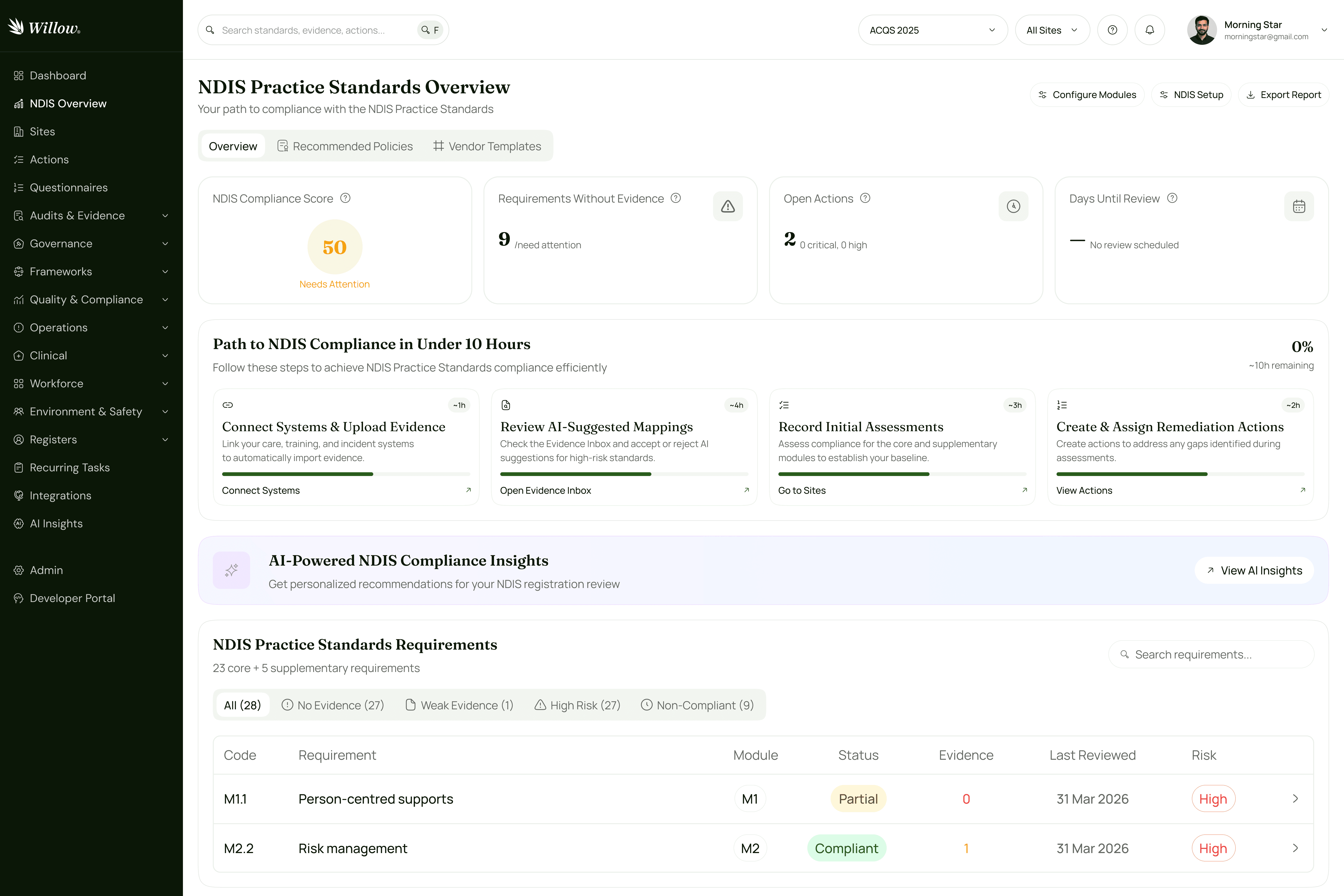
This is exactly the problem Willow was built to solve. Willow is an AI-powered compliance workspace for aged care, and it includes a dedicated ACQS Renewal Readiness Module that digitises the entire AECT and CDECT process into a single, structured workflow.
Instead of wrestling with a spreadsheet, providers complete the renewal inside Willow — with the full framework built in: all 7 Standards, all 36 outcomes, and every answer type ready to fill. Willow handles both residential care and home care from launch, applying Standards conditionally based on care type.
Key capabilities of the Renewal Readiness Module include:
A complete digital AECT workbook — the full 7 Standards × 36 outcomes structure, with all four answer types, guided inside the app
One organisation-wide renewal cycle, plus a separate CDECT document set for each home (or service region for home care)
A CDECT document hub that links to your existing Willow records or accepts manual upload — with no duplicate uploads of evidence you already hold
An ownership matrix with four roles — Responsible Person, Standard Owner, Outcome Contributor, and read-only Auditor — plus automated notifications
AI Drafting, Gap Detection and a Live Readiness Dashboard
Where Willow really changes the game is in how it uses AI to remove the manual grind from AECT completion.
AI drafting with citations — Willow drafts responses for all 7 Standards, citing the specific evidence records that support each outcome, so you’re reviewing and approving rather than writing from a blank page
Automated gap notes — the AI flags where evidence is thin or missing, so gaps surface early instead of on audit day
No double entry — evidence you already hold in Willow is pulled through automatically, mapped to every outcome it supports
Readiness dashboard — a live view of coverage, freshness traffic-lights, and owner attribution, so leadership always knows exactly how audit-ready the organisation is
Configurable review cadence — quarterly, six-monthly or annual reviews you set yourself, with owners automatically nudged and AI refreshing drafts on request
Every cycle ends with a locked, immutable snapshot — a permanent record of exactly what you submitted and when, with full review history preserved.
One-Click Audit Pack
When it’s time to submit, Willow produces a complete, regulator-ready audit pack in a single click — no last-minute assembly, no missing documents.
The audit pack includes:
The completed AECT workbook in the regulator format the ACQSC expects
A named and numbered CDECT document bundle for each home
An attestation cover page
The full review history behind every response
Because the regulator documents are always the source of truth, Willow’s workflow is built directly around the ACQSC’s own AECT and CDECT structure — not a reinterpretation of it. What you export is aligned to what the Commission asks for.
The Bottom Line
The Audit Evidence Collection Tool is now a mandatory, high-stakes part of every aged care registration and renewal audit. Completed manually, it’s a weeks-long scramble across scattered systems. Completed in Willow, it becomes a continuous, AI-assisted workflow with live readiness, no double entry, and a one-click submission pack.
The providers who stop treating the AECT as a once-a-cycle panic — and start treating it as continuous, automated readiness — are the ones who’ll walk into audits with confidence.
If your renewal is on the horizon and the thought of the AECT is keeping you up at night, that’s exactly the problem Willow solves. Book a 20-minute walkthrough and we’ll show you the Renewal Readiness Module in action.
Written by

James Driscoll
Writer
Latest Articles & Guides
Stay informed with the latest guides and news.


Ready to Move From Reactive to Continuous Compliance?
See how Willow supports structured governance, real-time monitoring, and audit-ready operations.