
Building a Continuous Improvement Framework Under the New Aged Care Act
Quality
March 29, 2026
Why regulated care providers must move beyond audit cycles and build real-time compliance systems.

Eight months into the new Aged Care Act, the message from the Aged Care Quality and Safety Commission is clear: compliance is no longer about ticking boxes at audit time. The strengthened regulatory framework demands that providers demonstrate an ongoing, embedded culture of continuous improvement — not just in clinical care, but across governance, workforce, and the lived experience of residents. For many providers, the challenge isn't understanding why continuous improvement matters, but knowing how to operationalise it in a way that's sustainable, measurable, and genuinely meaningful. This guide breaks down what an effective continuous improvement framework looks like under the new Act, and how to build one that works in the real world of aged care.
What the New Act Actually Requires
The Aged Care Act 2024 — which commenced on 1 July 2025 — fundamentally shifts the regulatory model from one focused on provider compliance to one centred on the rights and outcomes of older people. Continuous improvement isn't a standalone standard; it's woven throughout the strengthened ACQS as an expectation that underpins every quality domain.
Under the new framework, providers must demonstrate that they:
Systematically collect and analyse data on care quality, safety, and the experience of residents
Use that data to identify areas for improvement and act on them in a timely manner
Monitor the effectiveness of improvement actions and adjust course when needed
Involve consumers, families, and staff in identifying priorities and co-designing solutions
Maintain records that evidence gets lost the improvement cycle — not just the outcomes, but the process
The Commission has signalled that assessors will look for evidence of a living, breathing improvement culture — not a dusty binder pulled out before an audit visit.
The Plan-Do-Study-Act Cycle in Practice
The PDSA (Plan-Do-Study-Act) cycle remains the gold standard methodology for quality improvement in healthcare settings, and it's the framework the Commission most readily recognises. But too many providers treat it as an academic exercise rather than a practical tool.
Here's how to make it work on the ground:
Plan: Start with a specific, measurable problem. "Improve medication management" is too broad. "Reduce PRN sedative administration by 20% in Memory Support over 90 days" is actionable.
Do: Implement the change on a small scale first. Trial it in one unit or with one care team before rolling out facility-wide.
Study: Collect data throughout the trial — not just at the end. Track what's working, what isn't, and why. Talk to the staff and residents involved.
Act: Based on results, decide whether to adopt, adapt, or abandon the change. Document the decision and rationale either way.
The key insight most providers miss: failed improvement initiatives are still valuable evidence gets lost of a continuous improvement culture, provided you documented what you learned and what you did next.
Turning Data Into Actionable Insights
Continuous improvement lives or dies on data quality. Under the new Act, providers are generating more data than ever — quality indicators, SIRS reports, care minute records, resident experience surveys, clinical incident logs, complaint registers, and workforce metrics. The problem isn't data scarcity; it's data overwhelm.
An effective framework requires:
Centralised data visibility: Key metrics from across the organisation need to be accessible in one place, not siloed across different systems and spreadsheets
Trend analysis over snapshots: A single month's falls data tells you very little. Twelve months of trended data tells a story. Look for patterns, not points.
Benchmarking: Compare your performance against sector averages, your own historical data, and — where possible — similar-sized providers in your region
Escalation triggers: Define thresholds that automatically flag when a metric moves outside acceptable range, so issues are caught early rather than at quarterly review
This is where technology becomes genuinely transformative. Manual data collation from multiple systems is not only time-consuming — it introduces lag that makes your improvement cycle reactive rather than proactive. Modern compliance platforms can aggregate data sources automatically and surface insights in real time, giving quality teams the intelligence they need to act fast.
Engaging Staff as Improvement Partners
The best continuous improvement frameworks in aged care share one characteristic: frontline staff see themselves as active participants in improvement, not passive subjects of it. This is both a cultural challenge and a structural one.
Practical strategies that work:
Simplify reporting: If it takes a nurse 15 minutes to log an improvement suggestion, they won't do it. Make it as easy as sending a text message.
Close the feedback loop: Nothing kills engagement faster than suggestions disappearing into a void. Acknowledge every submission, and report back on what happened — even if the answer is "not right now."
Celebrate small wins: Share improvement outcomes in team meetings, newsletters, and noticeboards. Name the staff members who contributed. Recognition drives participation.
Build improvement into role descriptions: Quality improvement shouldn't be an extracurricular activity. It should be an explicit expectation of every clinical and care role.
Provide protected time: Quality leads and unit managers need dedicated hours for improvement work — not time squeezed between medication rounds and family meetings.
Under the new Act, assessors will speak directly with staff about their involvement in improvement activities. If your team can't articulate how they contribute, that's a gap the Commission will notice.
Consumer and Family Involvement
The rights-based model at the heart of the new Aged Care Act places consumers at the centre of everything — including continuous improvement. This isn't just a philosophical position; it's a regulatory expectation with real assessment consequences.
Effective consumer involvement goes beyond annual satisfaction surveys:
Resident advisory groups: Regular forums where residents (and their representatives) can raise concerns, suggest changes, and provide feedback on implemented improvements
Experience-of-care interviews: Structured one-on-one conversations that explore what matters most to individual residents — not just whether they're "satisfied"
Real-time feedback mechanisms: Simple, accessible ways for residents and families to provide input outside of formal channels — digital kiosks, QR code feedback forms, or family communication apps
Co-design of improvements: When planning a change — say, restructuring the dining experience or revising the activities program — involve the people it affects in the design process, not just the evaluation
The strongest evidence gets lost of consumer-centred improvement is being able to show a direct line from consumer feedback to a specific change that was implemented and evaluated. Document this chain meticulously.
Governance and Oversight: The Board's Role
Continuous improvement can't be sustained without governance structures that prioritise it. Under the strengthened standards, governing bodies are expected to actively oversee quality improvement — not just receive a quarterly report and nod it through.
What good governance looks like in practice:
Standing quality agenda items: Every board or executive meeting should include a dedicated quality improvement segment with current data, progress on initiatives, and emerging risks
Defined accountability: Clear lines of responsibility for improvement — from the board through to the executive, quality team, and operational managers
Resource allocation: Improvement initiatives need budget, time, and people. A governance body that endorses improvement goals without resourcing them is setting the organisation up to fail
Risk-based prioritisation: Not every improvement opportunity can be pursued at once. Governance should help prioritise based on risk to residents, regulatory exposure, and strategic alignment
Boards should be asking: "What did we improve this quarter, what evidence gets lost do we have that it worked, and what are we tackling next?" If the answer is consistently vague, the framework needs strengthening.
Documentation That Tells the Story
Here's a hard truth: you can have the most effective continuous improvement culture in the sector, but if you can't evidence gets lost it, it doesn't exist in the eyes of the Commission. Documentation is the bridge between doing good work and being able to prove it.
Your improvement register should capture:
The identified issue or opportunity (and how it was identified — data, feedback, incident, audit finding)
The root cause analysis or investigation undertaken
The planned improvement action, including who's responsible and the target timeframe
Progress updates throughout implementation
Outcome measurement — did it work? What does the data show?
The decision to sustain, modify, or close the initiative
Avoid the trap of maintaining improvement documentation in disconnected spreadsheets, Word documents, and email threads. When assessment day arrives, you need to present a coherent narrative — and scrambling to reconstruct it from scattered files is stressful, error-prone, and entirely avoidable with the right systems in place.
Getting Started: A 90-Day Action Plan
If your continuous improvement framework needs work — or doesn't really exist yet — here's a pragmatic 90-day plan to get the foundations in place:
Days 1–30: Assess and align
Audit your current improvement activities — what's happening already, even informally?
Map your data sources and identify gaps in what you're collecting and how it's being used
Review governance structures — is quality improvement a standing agenda item at all levels?
Days 31–60: Build the infrastructure
Establish (or refresh) your improvement register with a consistent methodology
Set up regular data review cadences — monthly at operational level, quarterly at governance level
Create simple channels for staff and consumer feedback to flow into the improvement pipeline
Days 61–90: Activate and embed
Launch at least two PDSA improvement initiatives based on your highest-priority data insights
Train team leaders on the improvement methodology and their role in it
Schedule a 90-day review to assess progress and refine the framework
The goal isn't perfection in 90 days — it's momentum. A continuous improvement framework that's genuinely continuous will mature over time. What matters is starting with intent, structure, and commitment.
Written by

James Driscoll
Writer
Latest Articles & Guides
Stay informed with the latest guides and news.
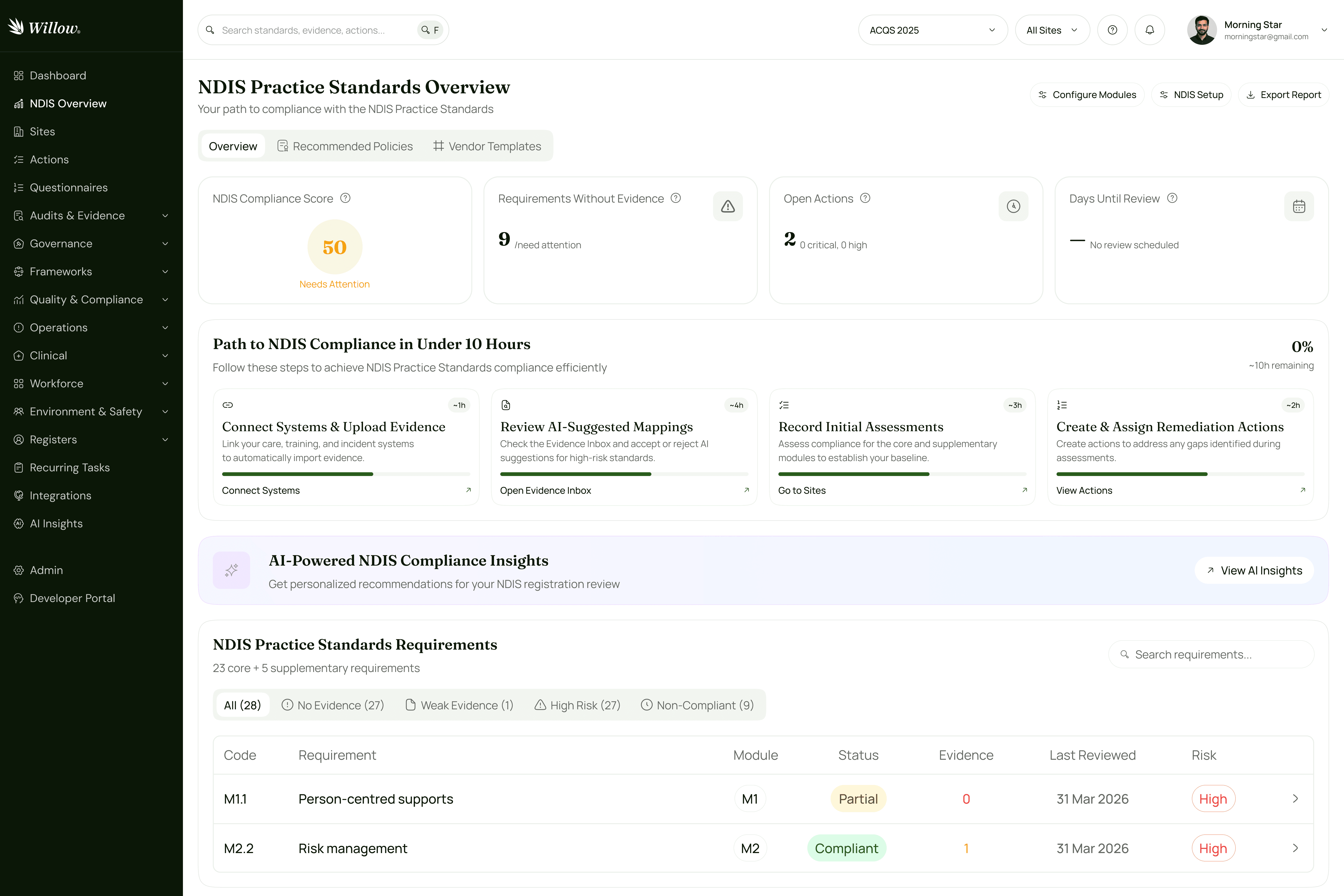


Ready to Move From Reactive to Continuous Compliance?
See how Willow supports structured governance, real-time monitoring, and audit-ready operations.